



Game Bird Regulations
Please Remember
Federal regulations prohibit the use of lead shot or cross-bows for hunting waterfowl.
Be Aware!
IN ALBERTA WHOOPING CRANES ARE PROTECTED
Whooping Cranes are listed as and Endangered Species in Alberta. Be sure your target is not a whooping crane.
IN ALBERTA SAGE GROUSE ARE PROTECTED
Sage grouse are listed as an endangered species in Alberta. Be sure your target is not a sage grouse.
IT IS PROHIBITED TO HUNT SHARP-TAILED GROUSE IN MANY WMUS WITHIN ALBERTA
(see Game Bird Seasons for allowed WMUs)
Be sure of your target. For a more detailed description of Sharp-tailed Grouse, please go to:
mywildalberta.ca/hunting/game-species/default.aspx
All birds are protected except the following: Starlings, Crows, Pigeons, House (English) Sparrows, Magpies, Blackbirds, Common Grackles, Brown-headed Cowbirds, Ravens (hunted on private land by residents and public land under an agricultural disposition) and any other birds for which an open season has been declared by the regulations as indicated in this summary.


Falconry Hunting
Falconers are permitted to hunt upland game birds and migratory birds, by means of falconry, in all areas of the province except in national parks and those restricted areas identified within this website (click here).
To hunt any game birds by means of falconry, Recreational Falconry Permit holders must possess all the same hunting licence(s) as those who would hunt game birds with firearms are required to possess (click here for more information).
Seasons
The open season to hunt upland game birds by means of falconry is from August 15, 2025 to March 31, 2026. Migratory game birds may be hunted by means of falconry during the designated open season for migratory birds. (click here for WMU seasons and dates).
Bowhunting
Hunters wishing to hunt game birds with a bow and arrow, other than a cross-bow, require a Bowhunting Permit in addition to the other applicable licences.
In accordance with federal regulations, cross-bows may not be used for waterfowl hunting.
Special Hunting Areas
In WMUs 212, 247 and 248 the hunting of game birds is only permitted with bows and arrows, cross-bows, shotguns or a falconry bird. Cross-bows cannot be used to hunt migratory birds.
In WMU 410 the hunting of game birds is permitted only with bows and arrows or a falconry bird.
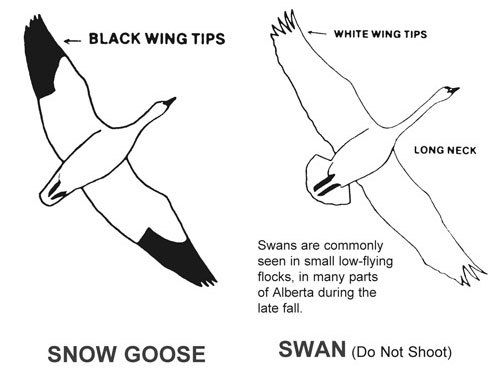
SNOW GOOSE AND SWAN IDENTIFICATION
Spring Snow/Ross' Goose Hunting Season
Alberta will have a spring snow/Ross’s goose hunting season from March 15 through June 15 annually. Please refer to the game bird hunting table (Click Here) for valid WMUs. Regular fall hunting restrictions and daily bag limit (50) apply. As in the fall hunting season, there is no longer a possession limit for snow/Ross’s geese.
NOTE: While it is illegal to hunt migratory game birds with a single projectile (e.g. .22 rim fire, or center fire rifle), it is legal to use them to hunt upland game birds and wild turkey.
Wild Turkey Draw
Please refer to items 1, 11 and 12 of Prohibitions, Game Bird section for additional requirements concerning weapons and evidence of sex and species for wild turkey.
Differentiating Between Males and Females
The gobbler (male) has a fleshy growth (wattle) which hangs from the under side of the throat or chin. Males also exhibit fatty growths (caruncles) located on the side and back of the neck and on the lower throat. A fleshy projection above the bill of males (snood, or dew bill) will also distinguish males from females.
| Common Characteristics to Differentiate Males and Females | ||
| Characteristic | Female | Male |
| Beard | Very rare, short | Regularly, up to 25cm (10”) long |
| Gobble | Never | Frequently, especially in spring |
| Head Colour | Grey-brown, grey-blue | Bright turquoise blue, bright red, bright blue, sometimes grayish white |
It is unlawful to hunt any wildlife or discharge a firearm between one-half hour after sunset and one-half hour before sunrise.
| Sunrise/Sunset Table (Mountain Daylight Time) | ||
| Date | Sunrise | Sunset |
| May 01, 2026 | 6:13 AM | 8:54 PM |
| May 05, 2026 | 6:06 AM | 9:00 PM |
| May 10, 2026 | 5:59 AM | 9:07 PM |
| May 15, 2026 | 5:51 AM | 9:14 PM |
| May 20, 2026 | 5:45 AM | 9:20 PM |
| May 25, 2026 | 5:40 AM | 9:27 PM |
| May 30, 2026 | 5:35 AM | 9:32 PM |
Attention Turkey Hunters
Fish and Wildlife will be conducting a hunter harvest survey after the fall hunting season to obtain information required for turkey management. Your cooperation and assistance in collecting and providing the necessary information is required. We request that you keep track of the number of days hunted in each WMU.
Double Crested Cormorants
Double-crested cormorants are a game bird and can be legally hunted during duck seasons with a provincial game bird hunting licence. Their flesh may be abandoned or wasted BUT dead birds must be recovered from the field and disposed of.